
Bixby City Directory Holdings
Bixby city directory research is usually a shelf-and-catalog search, not one complete municipal roll. Tulsa City-County Library documents selected Tulsa City Directory volumes at Central Research Library, including 1928 through 1932, 1939 through 1941, and 1948. Its Tulsa and Oklahoma History service also identifies 1909 through 1935 directories available at library locations through Ancestry Library Edition, with selected 1910, 1920, 1921, and 1922 volumes digitized for remote access. These collections can provide useful Bixby leads, but a Bixby address must still be read in the context of the volume and its coverage.
| Collection | Years | Where held | Access |
|---|---|---|---|
| Tulsa City Directory volumes | 1928-1932, 1939-1941, 1948 | Central Research Library | Library research collection |
| Tulsa directory run | 1909-1935 | Tulsa City-County Library locations | Library database access |
| Selected Tulsa directories | 1910, 1920-1922 | Tulsa digital directory collection | Remote digital access |
| Bixby Bulletin | Digitized issues from 11 years | Gateway to Oklahoma History | Online, incomplete run |
Start with the collection closest to the date in question. A gap between listed years does not establish that a household left Bixby, and it does not mean the directory ceased publication. The local digital newspaper run is also incomplete. Note: Record the title, edition year, page, and access date before treating any entry as evidence.
Bixby Library Routes to Directories
The Bixby branch of Tulsa City-County Library is at 20 E. Breckenridge and offers public computers, copying, scanning, and fax service. Its published schedule is Sunday closed, Monday 10-6, Tuesday 12-8, Wednesday 10-6, Thursday 12-8, Friday 10-6, and Saturday 10-5. The branch is a practical first stop for catalog help or access questions, while deeper Bixby city directory work may need Central Research or the Genealogy Resource Center.
The branch has an unusually relevant local-history connection. Library service in Bixby began in 1963 after the county library system formed following State Question 392. The first Bixby library operated at the same Breckenridge address, with 3,000 volumes and a limited weekly schedule. That continuity helps explain why regional library holdings are central to Bixby historical research.
The Genealogy Resource Center at Hardesty Regional Library offers books, microfilm, microfiche viewers, maps, atlases, surname files, directories, and library research tools. Materials are for in-library use. Newspaper and directory requests are possible, but broad microfilm research is in person and staff do not conduct full research projects. Genealogy appointments require an active card and three days’ notice. Central Research Center use is by appointment with 48 hours’ advance notice and a one-hour-per-day limit.
See the Bixby branch information before visiting for current service details.
For materials held elsewhere, the branch can be the place to confirm the next catalog or research-center step rather than a promise that every directory volume is on its own shelves.
Bixby City Directories Online
The Tulsa digital directory collection describes records with addresses, occupations, complete business directories, and advertisements. A remote item is most useful when its title, year, page or image number, and visible fields are kept together in a research note. If the viewer does not permit copying, save the item URL and page reference instead of guessing from a search snippet.
Digitization improves access but does not make the set complete. A digital image can preserve what the publisher printed for a particular year, while an unscanned year may still survive in a library volume or on microfilm. The collection is best used beside the library catalog and its physical holdings, not as a replacement for them.
The digital collection shows the type of directory material available online.
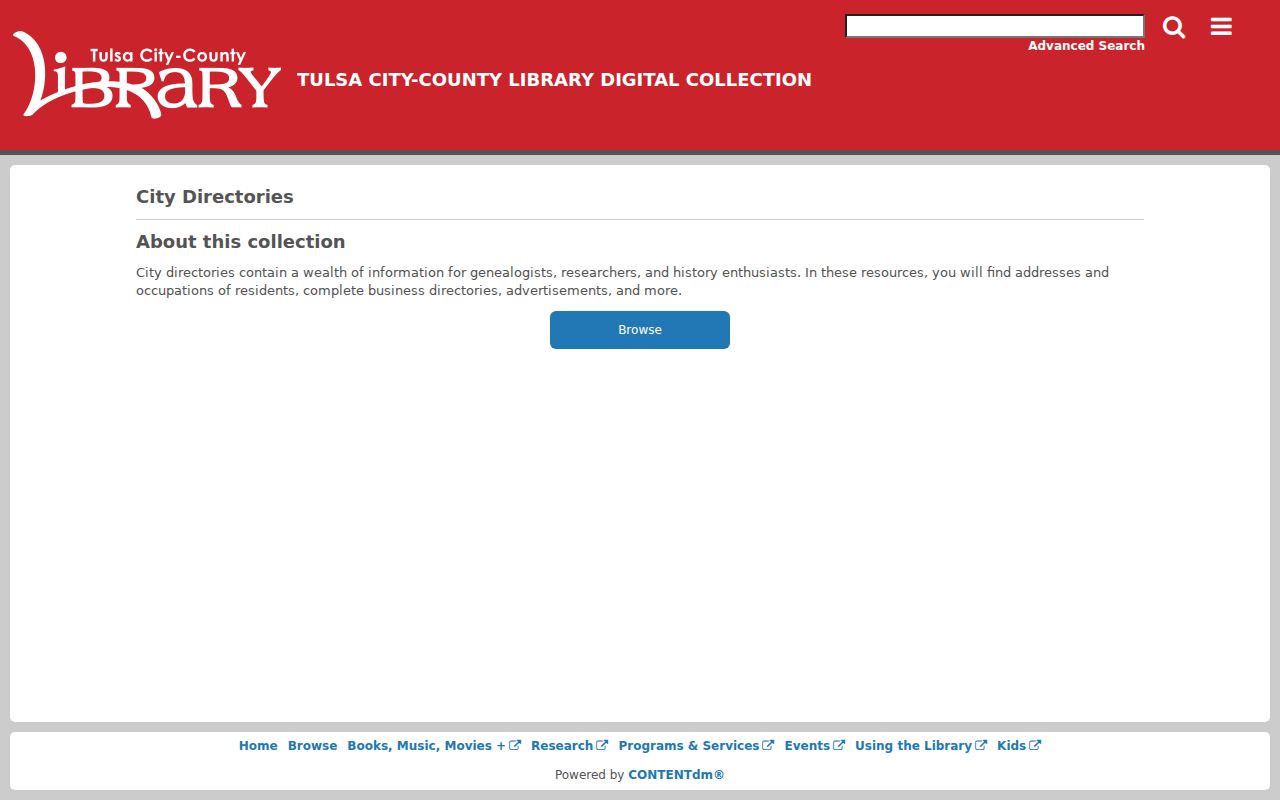
A city directory entry is time-stamped by its edition. It should be described as a listing for that edition, not as a statement that the same person remained there before or after publication.
Read a Bixby City Directory Listing
A Bixby city directory entry may identify an adult by name, then attach a street address, occupation, household or business association, and sometimes telephone information. Editorial conventions differ across volumes. Read the front matter and abbreviation key before deciding what a short label means. A name in a business listing, for example, is not the same as a household listing.
| Name | The person or business as printed, including initials or spelling variants. |
|---|---|
| Address | A street location or mailing-style address for that edition. |
| Occupation | Work or business information when the publisher included it. |
| Association | A household, business, or other printed connection, not proof of every relationship. |
| Telephone data | Sometimes included, depending on the edition and entry type. |
- Criss-cross directory
- An address-ordered directory section, where available, that can help locate listings by street rather than by surname.
- Householder index
- An index organized around a household name or address, useful for navigating an edition but limited to what that edition printed.
- Abbreviation key
- The publisher’s explanation of shortened terms, usually placed in the volume’s front material and essential for a careful transcription.
Keep the exact printed wording in your notes. “Listed at,” “owned,” and “resided” have different meanings, especially when comparing city directories with deeds or newspaper notices.
Bixby Bulletin Directory Clues
The Bixby Bulletin collection supplies a second historical layer beside Bixby city directories. The newspaper began in 1905, and the online collection reports 393 items and 2,602 pages from 11 years. The available run is not continuous, so a search with no result is a collection gap rather than proof that no notice, advertisement, or event existed.
A December 11, 1925 Bulletin issue provides useful item-level metadata: it is a four-page issue digitized from 35mm microfilm, and its record notes a January 25, 2025 addition date. The upload date describes access to the scan, not the date of the underlying event. This distinction matters when matching a Bixby directory listing to a newspaper item.
Use the printed date, title, page, and item identifier in the citation. A newspaper mention may be a strong lead, but its wording should not be expanded into a broader claim.
Bixby Beacon Dates Changed in 2025
The city’s Bixby Beacon page says the municipal publication changed from monthly to quarterly in 2025 and retains links to 2024 issues. That schedule change matters when a reader uses municipal news as a companion to city directory research. A gap after a monthly issue does not necessarily mean that a family, address, project, or public notice vanished from Bixby records.
Label a Beacon item by the issue date and identify whether it is municipal news, an announcement, or a notice. The publication schedule and the digitization schedule are separate facts. Neither one establishes a complete resident record, but both can help explain why a search window has uneven results.
Bixby Dates Behind Directory Research
Directory years make more sense when placed beside Bixby’s townsite history. The Oklahoma Historical Society describes a community associated with the Creek Nation before allotment, followed by a July 1899 post office, a February 1902 survey and April 1902 plat, the Midland Valley Railroad in 1904, and incorporation in December 1906. Older Bixby street references may therefore belong to a townsite-era record rather than a modern suburban parcel.
- 1899: Bixby post office established.
- 1902: Townsite surveyed and platted.
- 1904: Midland Valley Railroad arrived.
- 1905: Bixby Bulletin issued its first number and a new town was platted.
- 1906: Bixby incorporated.
The Oklahoma Historical Society’s Bixby entry is the source for this sequence. It is context for dating a source, not a substitute for the address, legal description, or edition year in the record being used.
Trace Bixby Families in Directories
Use Bixby city directories as a dated sequence. Begin with the edition closest to a known event, then work forward and backward through available years. Record spelling, initials, street wording, occupation, and every printed association. Compare each directory year to newspaper coverage, a cemetery record, or a deed only after preserving the source-specific meaning of each result.
- Find the person, address, or business in the closest available edition.
- Transcribe the entry and its page with the year of the volume.
- Check adjacent available editions for a move, omission, or changed spelling.
- Pair the sequence with dated newspaper material and the appropriate census period.
- Use a recorded deed or probate file to test a property-interest lead without equating it to residence.
For volumes and access methods, use the Bixby city directory collections described here. Modern parcel work belongs with the street directory rather than a historical shelf search.
Bixby Maps and Historical Memory
The October 1905 Bixby insurance map is a one-sheet townsite-era source associated with the Creek Nation. Insurance maps can show building footprints, materials, uses, streets, and fire-protection features. They cannot establish later occupancy, and they should not be stretched to cover newer Bixby subdivisions.
The Bixby Historical Society preserves local historical material at its museum, but no detailed searchable online collection inventory was located. Its listed public hours and appointment option make it a potential follow-up for a specific, narrow question. The official society membership form is not a resident list.
Note: A map, directory, and obituary can corroborate a time period while still describing different facts about a person or place.
Bixby Directory Results Need Context
Historical directories are useful because they preserve a printed snapshot. They also have clear limits. An entry can be stale, omitted, or tied to a business. The Bixby Historical Society has no detailed searchable online inventory, and the Bulletin’s online run has documented gaps. A missing result should be labeled as “not found in the consulted source,” not treated as proof that a person was absent from Bixby.
Use official or institutional sources, preserve source dates, and avoid combining sensitive details into an intrusive profile. Historical research can support family history, estate questions, and community history. It does not justify trying to locate or contact a living person at a private address.