
Bixby Previous Residents by Era
Previous residents of a Bixby address are best traced with sources that have an explicit date. Begin with the current parcel and legal description, then select the source that overlaps the era you need. The deed index can establish a recorded interest; a directory can show a listing at an address; a newspaper can preserve a dated notice; and a historic map can show whether the lot or structure existed. Do not collapse these into one claim.
| Source | Years it covers | Where held | What it shows |
|---|---|---|---|
| Tulsa Clerk name index | 1928-current | Tulsa Acclaim, with access limits | Indexed party and instrument leads |
| Tulsa legal-description index | 1987-current | Tulsa Acclaim, with access limits | Parcel-linked instrument leads |
| Tulsa directory holdings | Selected 1909-1948 runs | Tulsa City-County Library | Printed address and household listings |
| Bixby Bulletin online run | 11 documented years, earliest 1911 | Gateway to Oklahoma History | Notices, advertisements, and local items |
| Bixby insurance map | October 1905 | Oklahoma Historical Society through UNT | Townsite structures, streets, and uses |
Online coverage does not establish complete historical coverage. Wagoner County’s exact online historical index range was not located in official sources, and pre-1928 Tulsa research can require historical camera indexes, microfilm, in-person research, or a clerk request. Note: Preserve the source date separately from the date an archive added a scan online.
Route Bixby Address History First
Before tracing past residents, identify which county holds the Bixby parcel. Bixby’s corporate limits cross Tulsa County and Wagoner County. A mailing address or ZIP code alone does not select the right assessor, clerk, court, or election office. The Bixby Map Atlas and the county line are more useful starting points than a postal city label.
On the Tulsa side, use regional GIS and the assessor to preserve the situs address, parcel ID, subdivision, lot and block, section-township-range, and legal description. On the Wagoner side, use the official property-record landing page and GIS as locating aids. Both systems caution that maps are reference tools. Recorded plats and deeds control the legal description.
- Confirm the current situs address, not only the mailing address.
- Locate the parcel in the appropriate Tulsa or Wagoner GIS system.
- Record the parcel ID, legal description, and county before searching names.
- Use that county’s assessor for property characteristics and the clerk for instruments.
The Bixby Map Atlas and INCOG mapping resources support the Tulsa-side route. A property record shows ownership and parcel data, not a verified day-to-day occupant.
Bixby Previous Residents in Deed Indexes
County land records are the strongest route for a Bixby property-interest trail. The Tulsa Acclaim parcel search accepts a parcel number with Starts With, Contains, or Exact matching, plus document type and from-to date controls. It has a registered-account or fee-based access layer. A parcel search is often safer than a surname search when several people share the same name.
When a result is available, record the instrument number, document type, filing date, grantor, grantee, legal description, and image availability. A grantor conveys or releases an interest. A grantee receives one. Neither label, on its own, proves that the named person lived at the address. The Wagoner property-record page routes its county branch to separate assessor, clerk, and treasurer systems.
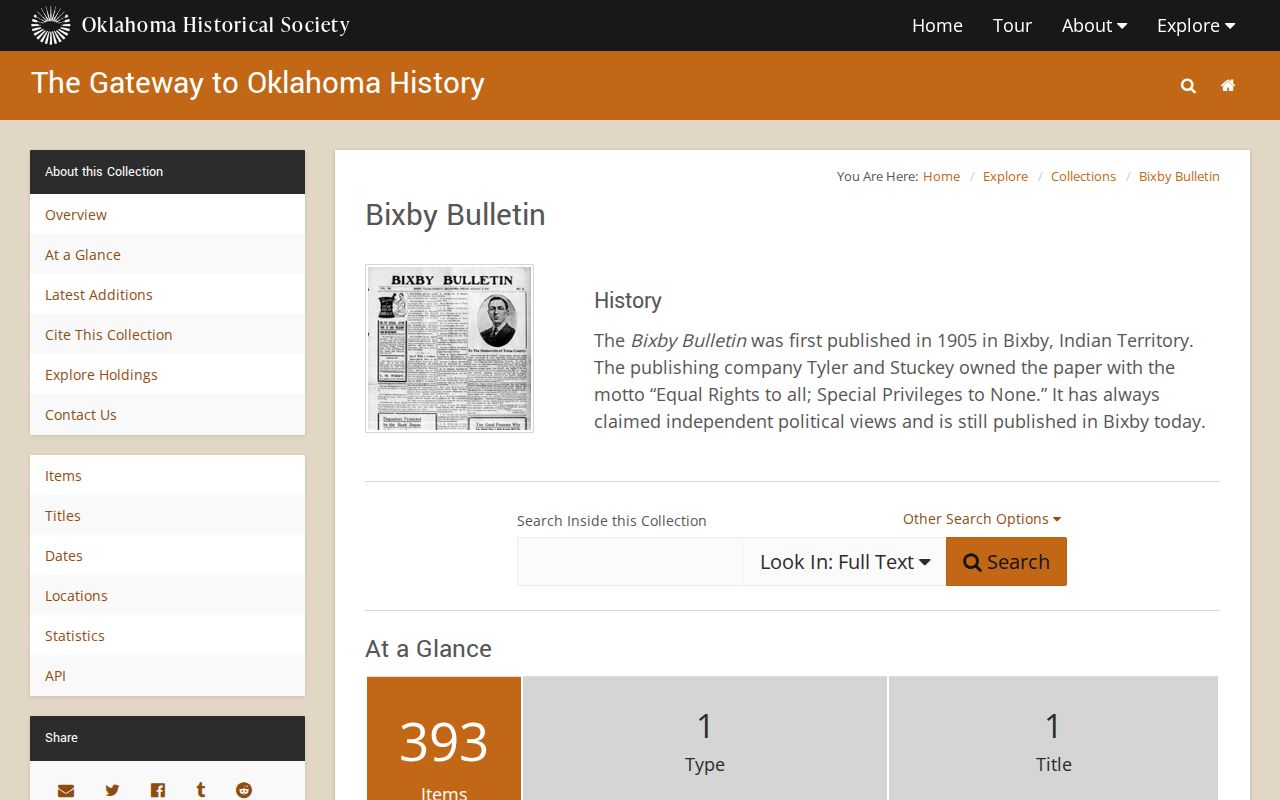
View the Bixby collection at Gateway for the newspaper layer that can sit beside a parcel trail.
Keep a separate column for “recorded interest” and “listed at address.” That simple distinction prevents a deed or directory lead from becoming an unsupported residence claim.
Trace Bixby Past Owners Backward
A chain of title is the sequence of recorded property interests, not a list of everyone who occupied a house. Start from the current parcel data and work to the earlier conveyance. At each link, compare the legal description as well as the street address. Street names, numbering, and lot boundaries can change across time, while the legal description is often the better bridge between instruments.
- Pull the current parcel’s account, parcel ID, and legal description from the correct county assessor.
- Search the county clerk’s parcel or name index for the most recent conveyance.
- Read the grantee and grantor, document type, recording date, instrument number, and legal description.
- Use the prior seller as the next grantee search and repeat the comparison backward.
- When the online index ends, move to the historical camera index, microfilm, in-person research, or a narrow clerk request.
- Grantor
- The party shown as conveying or releasing an interest in a recorded instrument.
- Grantee
- The party shown as receiving an interest in that instrument.
- Chain of title
- A dated sequence of recorded interests that must be checked document by document.
- Legal description
- The lot, block, subdivision, metes-and-bounds, or section reference tying an instrument to land more reliably than an old street label.
Search correction deeds, releases, estate or probate filings, survivorship language, and sheriff’s deeds when the sequence jumps. An assessor history is a lead, not a title opinion.
Bixby Past Residents Need Date Limits
Tulsa Clerk procurement material identifies online name indexing as 1928-current and legal-description indexing as 1987-current. Earlier Bixby research may need the historical camera index, microfilm, in-person clerk work, libraries, or the Oklahoma Historical Society. Wagoner’s exact online historical range was not located during official source inspection, so it should not be guessed from a no-result screen.
The Acclaim name search presents an alpha-index interface with AZ Volume and Last Name fields, but deeper results require its login or paid workflow. Tulsa County lists Land Records contact at landrecords@tulsacounty.org and 918-596-5801 option 3. Ask a narrow question with the county, parcel ID, legal description, instrument type, and date range instead of requesting every record tied to an address.
Bixby Previous Residents Before Modern Streets
Early Bixby sources use a townsite context that may not line up with today’s address search. The Oklahoma Historical Society dates the Bixby post office to July 1899, the townsite survey to February 1902, the plat to April 1902, the Midland Valley Railroad to 1904, a new town plat to 1905, and incorporation to December 1906. Those dates help explain why a modern street search can miss a townsite-era clue.
The Oklahoma Historical Society Bixby entry provides that historical sequence. Use it to date a source, not to infer a person’s address. Old maps and plats can help translate the physical setting, but recorded land descriptions remain the county record for a particular parcel.
- 1899: Post office established.
- 1902: Townsite surveyed and platted.
- 1904: Railroad arrived.
- 1905: New town plat and first Bixby Bulletin issue.
- 1906: Incorporation.
Note: Do not assume an old street name or a townsite map identifies the current parcel without a legal-description comparison.
Match Bixby Past Households
Past households add a different layer to previous residents research. Tulsa City-County Library documents selected directory holdings and remote digitized volumes, which can show a printed address, occupation, household or business association, and sometimes telephone information. A directory entry is a dated listing. It may be stale, omitted, or business-related, so it is not proof of continuous residence.
Pair each available edition with another dated source. Compare the address wording, spelling, page, and publication year. The collection details and how to read a listing are kept on the Bixby city directory page, while the backward address trail remains anchored in land records.
- Find the address or name in the closest available directory edition.
- Record the year, page, spelling, and exactly what the listing says.
- Check another available edition before concluding that a household moved.
- Compare the directory interval with the relevant census period, where available.
- Use a deed, probate file, obituary, or map to test the next dated lead.
Federal census material can add a household context, but a census address and a directory address still need to be compared carefully. Do not turn an owner, mailing recipient, or directory listing into a claim of occupancy without a source that says so.
Bixby Previous Residents in Maps
The Bixby Bulletin collection is useful for dated notices and local context, but its online run has gaps. The title page reports 393 items and 2,602 pages across 11 years, with the earliest digitized issue located in December 1911. An absent result identifies a gap in the online collection, not an absent person or event.
The October 1905 Bixby insurance map is one sheet associated with the Creek Nation. Insurance maps may show streets, building footprints, construction materials, uses, and fire-protection features. They are especially helpful for deciding whether a structure or street existed in the era of a directory or newspaper reference.
The map cannot identify later occupants or establish current parcel boundaries. Cite the map date and sheet, then pair it with a legal description or recorded plat for property-specific work.
Bixby Previous Residents and Probate
Probate can explain why a deed changed hands, but it is a county court record and must be routed to Tulsa or Wagoner based on the case. A probate file may include a decedent name, personal representative, will, inventory, notices, distributions, and addresses subject to access and redaction limits. It shows a legal proceeding, not automatic proof that every person named lived at the Bixby property.
Vital records follow different state rules. Oklahoma birth filing began in October 1908 and became mandatory in 1917, with inconsistent pre-1940 coverage. Death records 50 years or older are open for genealogical access, while birth records open after 125 years. The free OK2Explore index is a search lead, not a universal certificate-download service.
Use source verbs with care: “appeared in an obituary,” “was listed in a directory,” and “was named in an instrument” retain what each record actually establishes.
Use Bixby Address History Safely
Previous residents research in Bixby is appropriate for family history, house history, estate questions, and civic or archival work. It is not a reason to assemble private details about a living person or to try to reverse a protected address. Oklahoma’s Address Confidentiality Program can substitute a mailing address for qualifying participants. A missing or substituted address is not a data error to be solved.
Keep full dates of birth, identification numbers, protected addresses, juvenile information, and other sensitive material out of personal research notes shared with others. If a property record raises a deed-fraud concern, verify it with the appropriate county clerk rather than acting on an unsolicited notice.